
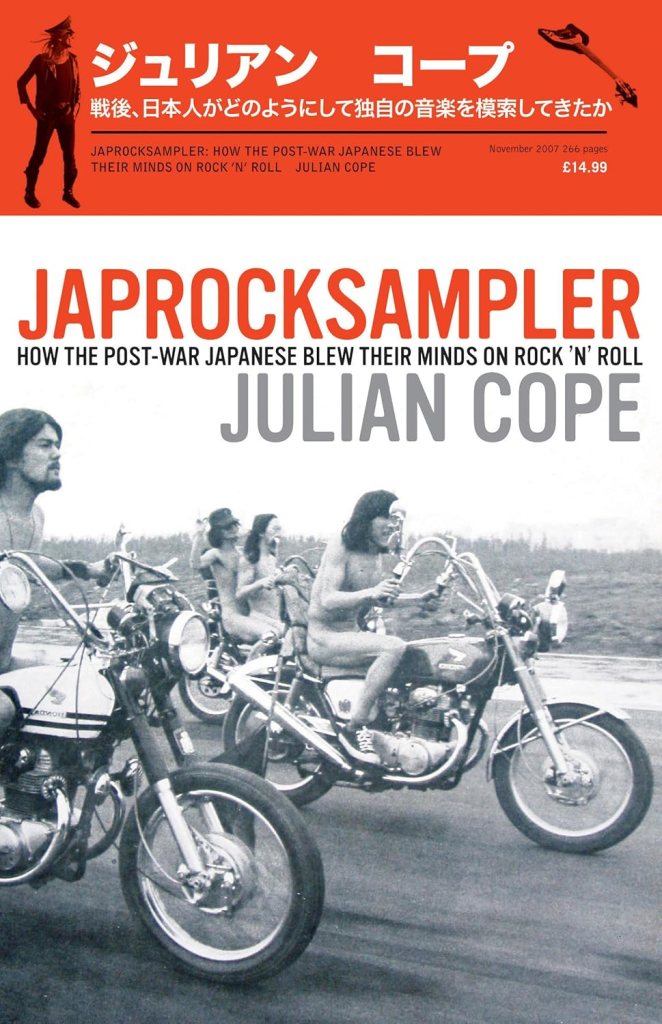
Everyone writes their own story of Japanese rock music. It’s a cultural phenomenon with so many facets that any attempt to capture it inevitably explains the author’s personality and perspective more than the history itself. Julian Cope’s Japrocksampler was published in 2009, and it still stands apart not just because of the topic but because of the author’s unique focus and unmistakable voice.
Japrocksampler survived all these years because Cope, a gifted musician and author of Krautrocksampler, knew exactly what kind of story he wanted to tell. He didn’t aim to cover every aspect of modern Japanese music. Instead, he traced the American rock ‘n’ roll journey to its Japanese incarnation, threading these developments through the political and social upheavals of the time. Because, you know, music doesn’t exist in a vacuum; it is politics, and pop culture is never just about the hits.
He paints vivid pictures of the first rock’n’roll covers, the Group Sounds of the 60s, the rise of progressive and folk-boom, and the experimental and theatrical scene, covered in great detail. He stops just a few steps before the punk explosion, leaving that chapter for someone else to tell. However, the essence of show business is captured accurately: styles may change, however, without any fundamental shift in the core on which the Japanese show business machine operates.
A big part of the Japrocksamplers’ charm lies in Cope’s universal perspective. He doesn’t treat Japanese rock as some mystical anomaly, an isolated phenomenon, but puts it within the global context, constantly drawing parallels with what was happening in the United States and Britain at the same time. This provides an understanding of Japanese popular music’s evolution as a piece of the larger cultural puzzle.
Yes, Cope is opinionated, Japrocksampler is not the work of an academic, journalist, or cultural critic, but rather of an educated enthusiast – it’s raw, honest, and unfiltered. Cope hands you the big names, the essential tracks, and says, “Hey, start here. Find your own way from this map I’ve scribbled.” Maybe it’s the closest thing to a rock ‘n’ roll manifesto about Japanese music you’ll ever find.

 Bad Lemon