
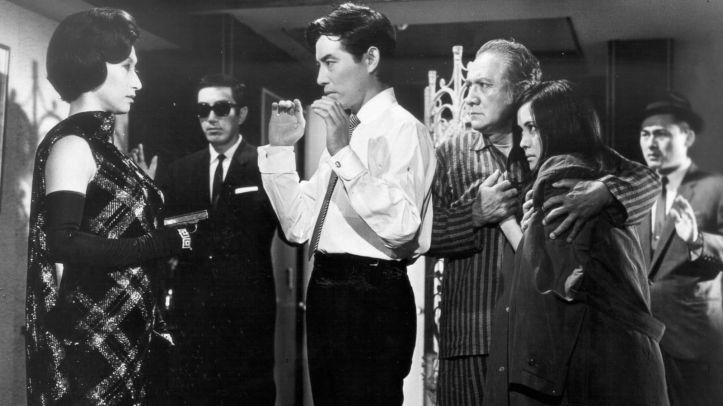
A mysterious villain hunts young men and women to abduct them and save their beautiful bodies for eternity by transforming them into lifelike mannequins. Will the brave detective be able to fight this twisted criminal mind and not fall for their charm? If the Black Lizard movie were to hit the cinema today, its logline could sound like that. Often dismissed as a pulp specimen, Black Lizard, if you dare to take it seriously, reveals a darker, more complex narrative that is still resonant today.
Black Lizard began as a stage adaptation of an Edogawa Rampo novel of the same name published in 1934, with a script by Yukio Mishima shifting focus to his favourite themes, such as eternal beauty and mortality. The first film, closely following Mishima’s script, released in 1962, was a lacklustre noir, watered-down reminiscent of The Maltese Falcon. More modern, action-like adaptation emerged in 1968, when avant-garde director Kinji Fukasaku (Tora! Tora! Tora!, Battles Without Honor and Humanity, Battle Royale) took the reins, casting as a title character Akihiro Miwa1 — a nowadays acknowledged drag star, who started as a cabaret singer, and back in the mid 1960s, sought to escape his established routes through enka music, socially themed lyrics and work in the theatre.
The choice of Miwa was no accident. In 1967, Shuji Terayama’s Marie in Fur, starring Miwa, drew sold-out crowds daily at the Shinjuku Art Theatre. Mishima was captivated by Miwa’s performance and frequently visited their dressing room. “You are the only one who can play Black Lizard. I beg you,” he said.
“Mishima was a very proud person,” Miwa recalls. “Not the kind to come and ask repeatedly. But three times? Why me?”
Having seen Miwa navigate Terayama’s notoriously complex scripts with ease, Mishima explained, “I thought you could convey my rhetorical and difficult lines to the audience in simple, everyday language as if you were using a soapbox or a toothbrush.”
When pressed further, he admitted a deeper reason: “I was told that none of the plays I write ever get an audience. That makes me sad. If you do it, it’ll definitely be a big hit.”2
And it was. Miwa first played the Black Lizard at the Toyoko Theatre in April 1968. The first performance was, as expected, a smash hit. It was later performed at the Kabuki-za theatre, where Mishima was delighted to play the role of one of the mannequins himself. Kinji Fukasaku directed a movie adaptation that was even screened in New York and Paris. Black Lizard thrived not only on screen but on stage, where Miwa reprised the role until the age of 79. Even late into his career, tickets sold out within hours.
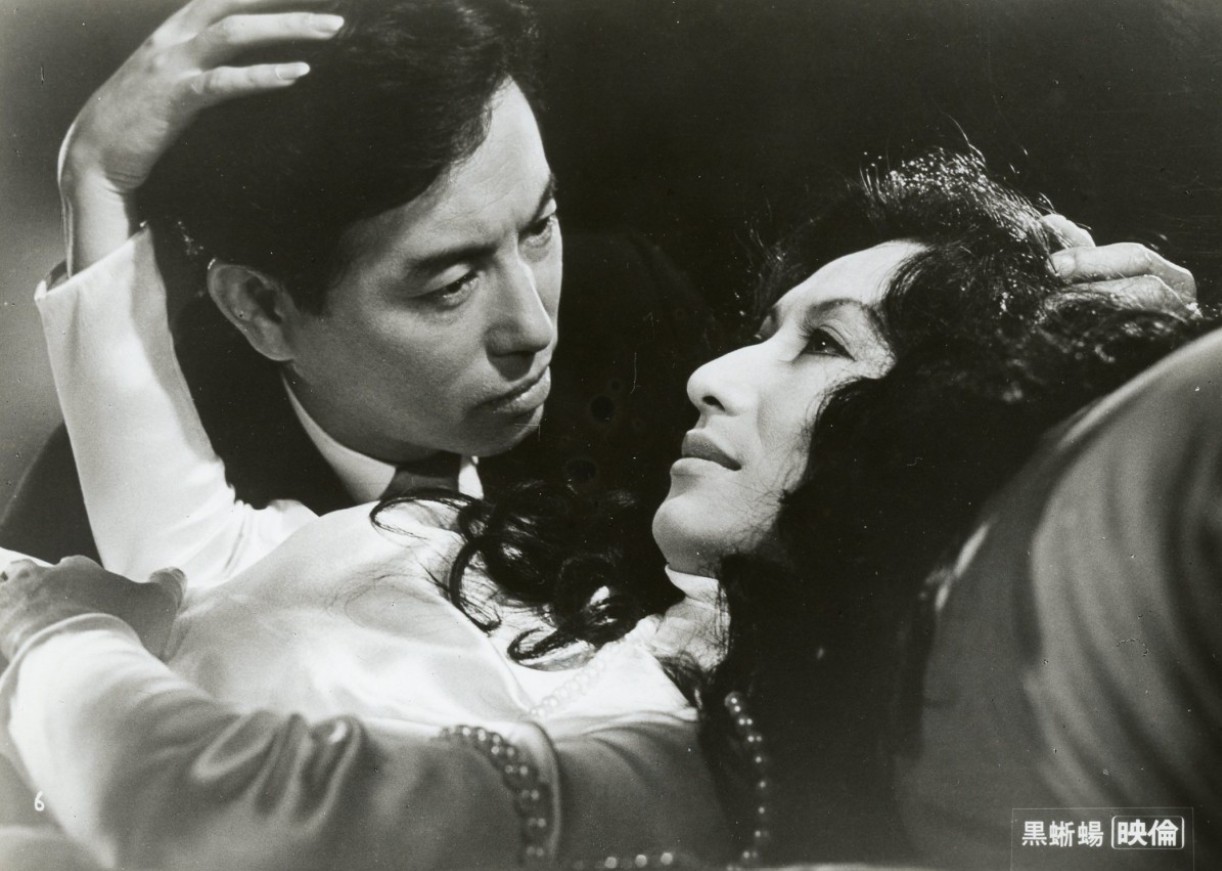
What gives Black Lizard its hypnotism? Part of the magic lies in its subversion of the onnagata tradition. In traditional Japanese theatre, the portrayal of the ideal woman fell to male onnagata actors, whose performances embodied an unattainable femininity, for the latter existed in such a configuration only on stage. Miwa’s casting reinvented this tradition on screen, blending the conventional with the avant-garde, which appears to be a striking evolution from the 1962 adaptation, more restrained and formulaic, with its cisgender character portrayals paling in comparison to the 1968 version’s daring sensuality and theatrical flair.
Also contributing to the film’s hypnotic allure are Miwa’s appearances in Black Lizard, which unfold not as transformations but as a seamless embodiment of the Black Lizard’s true self. Even though audiences then, as now, may have been tempted to frame this presence as ‘otherness,’ the Black Lizard does not appear to see themselves that way. They simply exist. To enhance this perception, viewers do not get to witness the male-to-female metamorphosis central to contemporaneous drag-centric works, such as Some Like It Hot (1959). Instead, ‘otherness’ is delivered as a premise. From the outset, Black Lizard arrives fully formed as a femme fatale, though we never get a hint on how the ‘femme’ came to be, nor what moral dilemmas or narrative traumas shaped the ‘fatale.’ The fatality holds until Black Lizard falls in love with the detective, as does another Miwa’s character, Ryuko, in another Kinji Fukasaku work Black Rose Mansion, with one of their presumed victims, revealing the character’s vulnerability, ripping off their unattainability, and bringing them back something unmistakably human.
In considering what else sets Black Lizard apart from other criminal masters of disguise of the era, Fantômas inevitably comes to mind, along with Jean Marais, who brought him to cinematic life. Like Miwa, Marais was a luminary of what we now recognize as the queer cultural vanguard. And yet, his Fantômas lacks the layered complexity Miwa lends to Black Lizard. Where Fantômas steals faces — literal masks of identity — it is not in service of a quirky philosophy, one that seeks to preserve beauty, and not in an extension of the character’s fluid essence. His disguises function as tools, a way to obscure his true self.
The Black Lizard has no such need for concealment. Their goal is not to hide; it’s to steal souls — those of her victims and, ultimately, the audience. The film ends, yet you’re left with the unsettling sense that something has just slipped through your grasp. Like a lizard.
At that time, he went under the name of Akihiro Maruyama, a pseudonym chosen in his early career years that he would later, after Mishima’s death and memorial service, change to Akihiro Miwa, by which he has been referred to since then.
- At that time, he went under the name of Akihiro Maruyama, a pseudonym chosen in his early career years that he would later, after Mishima’s death and memorial service, change to Akihiro Miwa, by which he has been referred to since then. ↩︎
- https://www.sponichi.co.jp/entertainment/news/2015/03/08/kiji/K20150308009936500.html ↩︎

 Bad Lemon